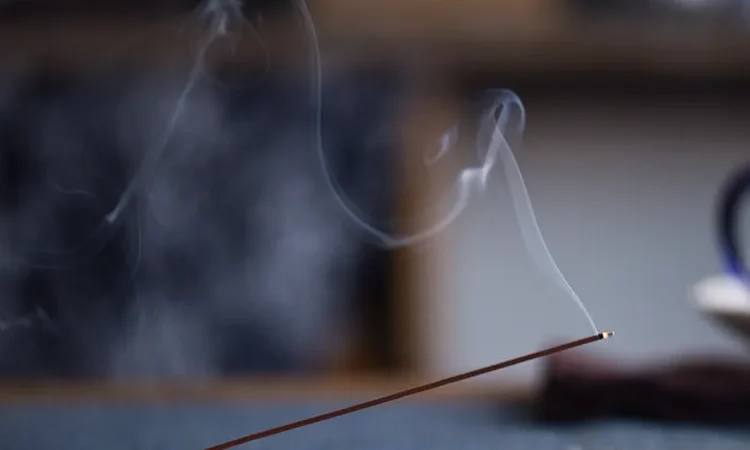
The first time I held a stick of traditionally handcrafted Chinese incense, I didn’t light it. I just held it, turning it slowly between my fingers, noticing things I’d never noticed about incense before.
The surface was slightly rough, matte rather than shiny. When I brought it close to my nose, there was scent—subtle, woody, alive—even unlit. The stick felt solid but not heavy, and when I finally did light it days later, it burned completely to soft gray ash, leaving nothing behind.
That simple experience taught me more about what “handcrafted” actually means than any product description ever could. And it began a journey into understanding why traditional Chinese incense is fundamentally different from what most Westerners think of when they hear the word “incense.”
What Makes It Handcrafted
In an age of mass production, “handcrafted” has become a marketing word, often meaning little. So let me be specific about what traditional Chinese incense craftsmanship actually involves.
The materials are whole and recognizable. Traditional incense starts with actual aromatic woods—sandalwood, agarwood, cypress—ground into fine powder. Not fragrance oils, not synthetic compounds, not “sandalwood scent” created in a laboratory. The wood itself, reduced to powder but otherwise unchanged.
The binder is natural. To hold the powder together, craftsmen use natural plant-based binders—traditionally elm bark powder or similar materials. These binders burn clean and don’t interfere with the wood’s natural scent.
The process is slow. The powder and binder are mixed with water into a dough, then pressed or rolled into shape and dried. Drying alone can take days or weeks depending on climate and thickness. There’s no way to rush this without compromising quality.
There’s no core to hide behind. Unlike dipped incense that coats a bamboo stick with fragrance paste, traditional Chinese incense is solid throughout. What you see is what you smell—nothing is masked or supplemented.
This matters because the end result is genuinely different. Handcrafted incense burns more evenly, produces cleaner smoke, and offers scent that evolves as it burns rather than hitting you with one synthetic note from start to finish.
Home Fragrance That Tells a Story
I’ve used candles, diffusers, room sprays—all the usual ways modern homes manage scent. They work fine. But Chinese incense offers something different: fragrance with cultural depth.
When I burn sandalwood in my living room, I’m not just making the space smell nice. I’m participating in a practice that Chinese households have maintained for centuries. Scholars burned incense while writing poetry. Families burned it to purify homes after illness. Temples burned it as offering, but ordinary people burned it simply because it made daily life more refined.
This history doesn’t make the scent objectively “better.” But it adds a layer of meaning that a mass-produced candle can’t provide. There’s something grounding about using a tool the way humans have used it for a thousand years.
Living With the Scent
Chinese incense integrates into home life differently than other fragrance options:
It has natural duration. A stick burns for 20-30 minutes, then it’s done. Unlike diffusers that run continuously or candles you forget to blow out, incense has built-in boundaries. The fragrance fills the room, then gradually fades. This rhythm feels more natural than constant artificial scenting.
It moves through the space. Smoke carries scent in ways that oil diffusers don’t. The fragrance drifts, settles, shifts with air currents. Different spots in the room smell slightly different. This creates a living, dynamic atmosphere rather than uniform saturation.
It marks moments. Because lighting incense requires a small intentional act, it naturally marks transitions. Coming home from work, I light a stick—the day’s stress stays at the door. Weekend morning, different incense—the pace shifts. The scent becomes associated with different modes of being.
Practical Considerations
For home fragrance use, a few things matter:
Ventilation is essential. Even clean-burning incense produces some smoke. Crack a window, run a fan on low, or burn in larger rooms. The scent will still be present and pleasant; it just won’t accumulate into haze.
Placement affects experience. Incense near the entrance scents the whole home as air moves. Incense in a corner creates a more localized atmosphere. Experiment to find what works for your space.
Quality determines everything. Cheap synthetic incense can leave your home smelling like a college dorm in the worst way. Traditional handcrafted incense, by contrast, leaves a subtle warmth that visitors often comment on positively—sometimes without even realizing incense was involved.
A Meditation Aid With Substance
Beyond home fragrance, Chinese incense has a specific application that drew me deeper into the practice: meditation support.
I’d tried meditating with apps, with timers, with nothing at all. Each approach had limitations. Apps kept me tethered to my phone. Timers created anxiety about the countdown. Sitting with no time structure led to sessions that were either too short or indefinitely long.
Incense solved this elegantly.
How It Works in Practice
Natural timing. One stick, one sit. When the incense finishes, the session is complete. No timer to watch, no phone to check. The duration is built into the tool itself.
Sensory anchor. Meditation instructions often say “return to the breath” when attention wanders. But breath is subtle, easy to lose. Incense provides a more robust anchor—when my mind drifts, the scent is there, gently pulling attention back to the present moment.
Ritual transition. The act of lighting incense creates a clear boundary between regular life and practice time. By the time the flame is blown out and the first smoke rises, my body already knows what’s coming. The ritual carries me into the meditation without requiring willpower.
Conditioning over time. After months of pairing a specific scent with meditation, the association becomes automatic. Now when I smell sandalwood, my nervous system begins settling before I even sit down. This isn’t mystical—it’s basic conditioning. But it’s powerful.
The Chinese Meditation Tradition
Chinese contemplatives have understood this for centuries. Chan (Zen) Buddhist monasteries incorporated incense into practice not as religious offering but as practical support. The scent clarified the mind, the smoke marked time, the ritual created container.
Taoist practitioners used incense similarly—not as worship but as technology for internal cultivation. Different blends for different practices, different times of day, different seasons.
Using incense for meditation connects you to this lineage. Not in a way that requires adopting beliefs or performing ceremonies—just in the simple recognition that you’re using a tool the way it was refined to be used.
Finding Your Entry Point
If you’re curious about bringing handcrafted Chinese incense into your life, here’s where I’d suggest starting:
For home fragrance: Begin with sandalwood. It’s warm, widely appealing, and unlikely to offend anyone in your household. Burn one stick in your main living space and notice how the atmosphere shifts.
For meditation: Same recommendation—sandalwood—but commit to using it consistently. Same scent, same time of day, for at least a few weeks. Let the association build.
For exploration: Once you’re comfortable with sandalwood, branch into agarwood for something deeper, or cypress for something lighter. Traditional Chinese incense offers a whole vocabulary of scents, each with different qualities and applications.
More Than Fragrance
What I’ve come to appreciate about handcrafted Chinese incense is that it refuses to be just one thing.
It’s home fragrance, yes—but fragrance with cultural weight and natural rhythm. It’s meditation aid, yes—but one refined over centuries of contemplative practice. It’s a sensory experience, but also a small daily ritual that connects modern life to ancient wisdom.
You don’t have to engage with all these layers. You can simply enjoy the scent and leave it at that. But the layers are there if you want them, waiting to be discovered as your practice deepens.
That, perhaps, is what “handcrafted” really means—not just made by hand, but made with intention, carrying forward something that machines and factories cannot replicate.
The wood was a tree once, growing slowly in some forest. Someone ground it to powder, mixed it with care, shaped it by hand, waited while it dried. Now it sits in your home, waiting to become smoke and scent and atmosphere.
Light it. See what happens.
New to Chinese incense? Start with our sandalwood collection—traditionally crafted, naturally scented, ready to transform your space.